Surgical Outcomes of Congenital Upper Eyelid Coloboma at Tertiary Care Hospital
Doi: 10.36351/pjo.v42i2.2323
DOI:
https://doi.org/10.36351/pjo.v42i2.2323Abstract
Purpose: To observe surgical outcomes of patients with congenital upper eyelid coloboma.
Study Design: Retrospective case series.
Place and Duration of Study: Armed Forces Institute Of Ophthalmology, Rawalpindi April 2023 to July 2023.
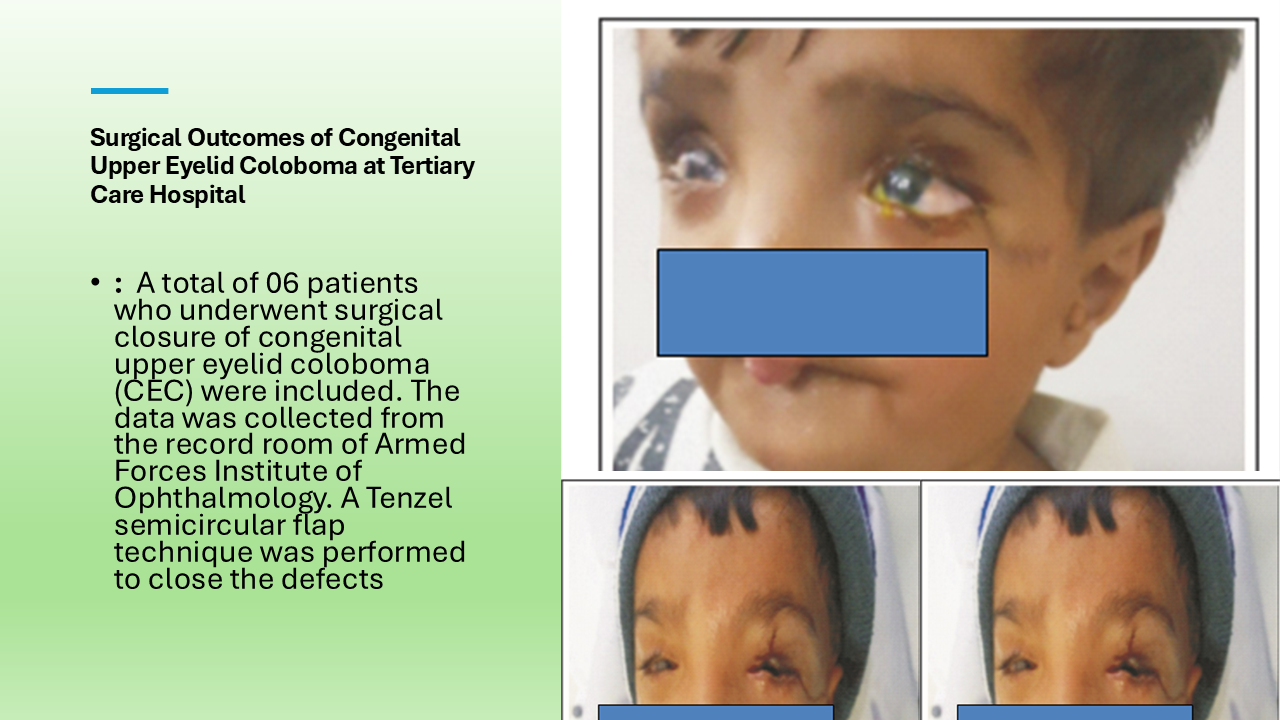
Methods: A total of 06 patients who underwent surgical closure of congenital upper eyelid coloboma (CEC) were included. The data was collected from the record room of Armed Forces Institute of Ophthalmology. A Tenzel semicircular flap technique was performed to close the defects. Data analysis was done with SPSS version 22.0.
Results: Out of six patients with upper eyelid coloboma, five (83.3%) were males and one (16.7%) was female. The mean age was 20.3 ± 5.2 months. Direct closure with cantholysis was performed in the right eye of two (33.3%) patients, while four (66.7%) patients underwent repair of the left eye using a Tenzel semicircular flap. Successful outcomes were achieved in five (83.3%) patients. One patient (16.7%) required redo surgery due to wound dehiscence, which occurred because of increased skin tension during childhood growth.
Conclusion: Surgical repair of congenital upper eyelid coloboma using direct closure with cantholysis for smaller defects and the Tenzel semicircular flap for larger defects provides favorable functional and cosmetic outcomes. In this series, the majority of patients achieved successful eyelid reconstruction, with only one case requiring redo surgery due to wound dehiscence. These findings suggest that appropriate selection of surgical technique based on defect size is effective for the management of congenital upper eyelid coloboma.
Downloads
Published
How to Cite
Issue
Section
License
Copyright (c) 2026 Murtaza Sameen Junejo

This work is licensed under a Creative Commons Attribution-NonCommercial 4.0 International License.